
Free written scope consultation - allowances, timeline, and change-order rules on paper before a single trade is scheduled


 Before
 After
After Before
 After
After Before
 After
AfterSterling Roofing: The Huntington Beach Owner’s Guide
Sterling-compatible roofing parts in Huntington Beach typically run $400-$1,800 installed for repairs, and we stock the common fasteners, flashing profiles, and membrane sections on our trucks. Most Sterling roof systems in this market are found on homes built between 1985 and 2005, and the failure pattern we see starts with the membrane under the tile or shingle layer, not the surface material itself. Owners usually discover the problem after a hard Santa Ana wind season, when lifted tiles reveal cracked underlayment, or when a ceiling stain appears after what seemed like a minor rain.
Grant Rowan still walks job sites on Saturdays with a cup of coffee, partly to check the work and partly because he hasn’t figured out how to stop - and he’s seen enough Sterling systems in Huntington Beach to know the failure points before the ladder goes up.
Which Sterling Models This Applies To
Sterling Roofing Systems operated primarily in the western U.S. from the late 1970s through the mid-2000s, and their product lines break into three eras that matter for parts matching. The early stamped-metal shingle systems (1978-1992) used a proprietary 12-inch exposure with a hidden fastener clip that Sterling discontinued in 1993 - we fabricate compatible clips from 26-gauge galvanized stock when the original corrodes. The mid-period concrete and clay tile systems (1992-2002) are more common in Huntington Beach, particularly in the tract homes near Beach Boulevard and the older neighborhoods inland from Pacific Coast Highway; these used a standard batten system but with a custom rake edge profile that standard big-box flashing doesn’t match. The final composite shingle line (2002-2006) was rebranded shortly after launch, and parts availability is spotty - we source through salvage yards and aftermarket mills for those.
To identify your system, check the underside of a lifted tile or the back of a loose shingle for a stamped “STERLING” mark and a four-digit date code. If the stamp reads “SRS” with a lightning bolt, you’ve got the 1980s metal shingle; “Sterling Tile” with a coastal scene logo indicates the 1990s batten system. No mark at all usually means a later composite or a re-roof with non-original material. We’re independent of Sterling Roofing Systems, so we cross-reference your markings against our parts book and fabricate what’s no longer manufactured.
The OEM-versus-aftermarket decision for Sterling comes down to how long you plan to keep the roof. Original Sterling fasteners and edge metal were zinc-coated to a standard that held up reasonably well in Huntington Beach’s salt air for 20-25 years; our aftermarket equivalents use G90 galvanizing or 300-series stainless, which buys another decade. For the membrane layer, we use ASTM D226 Type II felt or a synthetic underlayment that exceeds the original spec - the building code has moved on, and we don’t install to 1990s standards just because that’s what was there.
Signs Your Sterling Roofing Is Failing
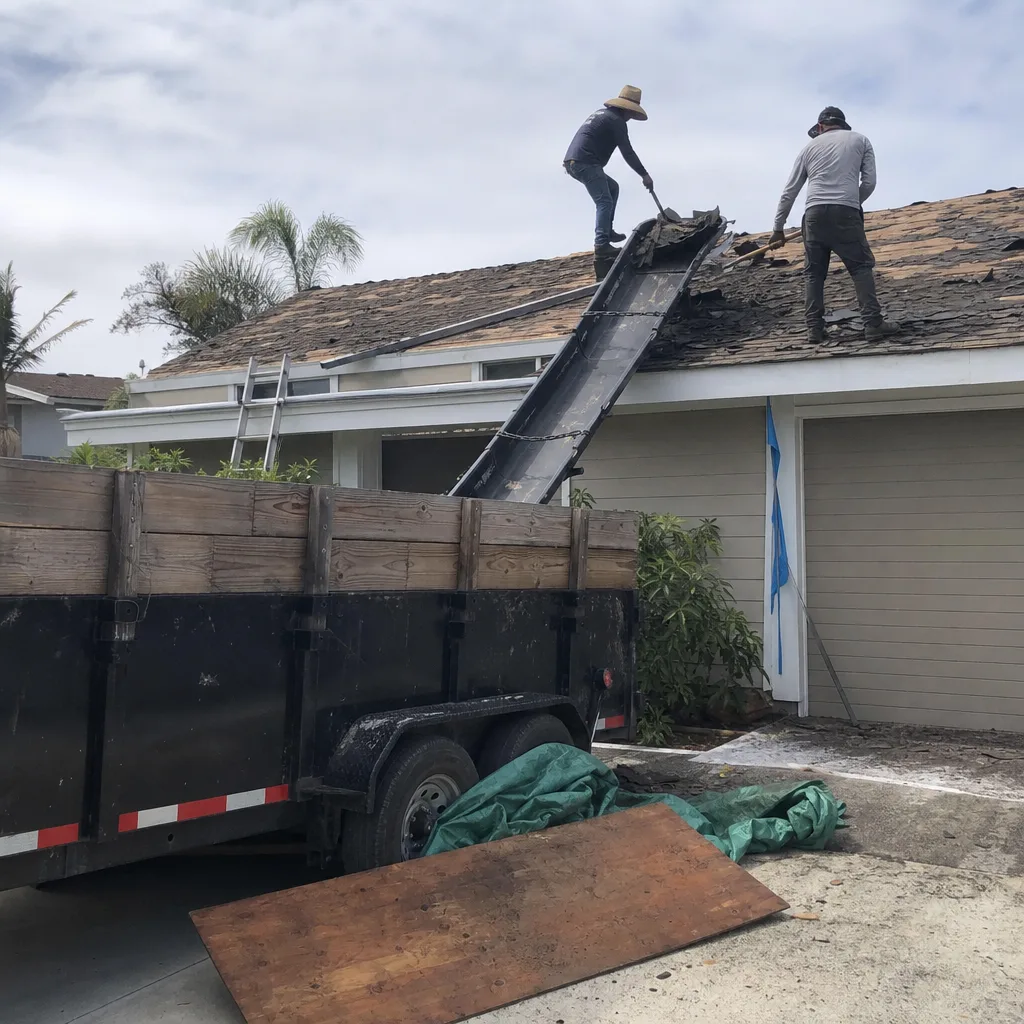
- Lifted or displaced tiles after wind events. The Santa Ana winds that hit Huntington Beach each fall test every fastening system. On Sterling tile roofs, the failure point is usually the corrosion of the nail or clip that secures the tile to the batten, not the tile itself. We find the nail head reduced to a rust ring and the tile sliding on the battens.
- Water stains on interior ceilings that appear after rain but dry quickly. This pattern points to membrane failure under the primary roof covering. Sterling’s original felt underlayment dries and cracks after 20 years of UV exposure at the edges and penetrations; water gets through, runs along the deck, and finds a ceiling joint.
- Granule accumulation in gutters or at downspout outlets. On Sterling composite shingle roofs, heavy granule loss exposes the asphalt substrate to direct sun. Huntington Beach gets roughly 280 days of sun annually, and unprotected asphalt oxidizes and cracks within two to three seasons.
- Sagging or wavy appearance along the roof plane. This indicates deck deterioration from long-term leakage, often at the valley or penetration flashings where Sterling’s original detail used a narrower flange than current best practice. The deck softens, the underlayment follows the contour, and the surface material telegraphs the problem.
- Daylight visible through the roof deck from inside the attic. On the stamped-metal shingle systems, this means a fastener has backed out or a clip has corroded through, leaving a gap. It’s the most urgent sign - the next rain enters directly, and the metal edge can cut like a blade if handled without gloves.
 Before
 After
AfterReplacement Cost & What’s Included
For Sterling-specific repairs in Huntington Beach, our installed pricing breaks down as follows:
| Scope | Price Range |
|---|---|
| Tile re-fastening and spot membrane repair (up to 50 sq. ft.) | $400-$800 |
| Valley or penetration flashing replacement with membrane | $800-$1,400 |
| Sectional re-roof (one slope, membrane and surface material) | $1,200-$1,800 |
The range reflects three variables: access difficulty (steep pitches or tight lots near downtown Huntington Beach add labor time), the extent of deck repair needed once we open the roof, and whether your Sterling system uses a discontinued part we need to fabricate. Under Clause 1 of the Haven Standard, we put the full scope and price in writing before work starts - no “time and materials” surprises. Every Sterling repair carries our 365-Day Done Right Promise: if the repair leaks or a fastener fails, we make it right. The documented photo record from your visit shows the condition we found and what we installed, included as standard.
DIY or Call Us?
Here’s where we’ll draw a clear line. A homeowner can safely walk the roof perimeter with binoculars to spot displaced tiles, check the attic for daylight or water marks, and photograph any Sterling stamps for identification - that’s useful information, and we welcome the photos when you call.
What we don’t recommend: lifting concrete tiles without knowing the load path (they break, and they hurt), working on a roof pitch steeper than 4:12 without proper fall protection, or attempting to heat-weld or torch-apply membrane patches. The underlayment on a Sterling system is your last waterproof layer; a gap there funnels water directly to the deck. And the stamped-metal shingles from the early systems have edges that will slice through a work glove.
We’re background-checked, uniformed, and we carry the fabrication tools and Sterling-compatible stock on our trucks. Call (657) 288-3368 to schedule your free estimate - we’ll identify the part, price the repair in writing, and get it on the schedule.
FAQs
The original Sterling systems were built for a 20-25 year service life in moderate climates. In Huntington Beach’s salt air and high UV exposure, we’ve found the membrane layer typically fails at 18-22 years, while the tile or metal surface material can last 30-plus if the underlayment is maintained. Call (657) 288-3368 for a condition assessment - estimates are free.
Spot repairs work when the failure is isolated: a few corroded fasteners, a single cracked tile, a localized membrane breach at a vent pipe. Once the membrane is brittle across a slope or the deck shows moisture damage, partial replacement is the honest recommendation. We don’t sell repairs that buy six months. Call (657) 288-3368 and we’ll show you the photo evidence before you decide.
Most repairs we quote are completed in one working day: arrival, setup, removal of the affected area, deck inspection and any necessary repair, membrane installation, and surface material replacement. Fabricated parts add a day if we need to run them through our sheet metal shop. We don’t quote same-day completion on planned repairs - the inspection and written quote come first, and the work is scheduled after you approve the scope.
We stock the fasteners, flashing profiles, and membrane sections that cover 80 percent of the Sterling repairs we encounter in Huntington Beach. Discontinued clips and custom rake edges are fabricated in our shop from measured templates taken on site. If your system needs a part we don’t have, we’ll tell you before we start and give you the lead time in writing. Call (657) 288-3368 to schedule - we’ll come prepared.
Written by Grant Rowan, Owner, Rowan Construction Group Huntington Beach at Rowan Construction Group Huntington Beach, serving Huntington Beach and nearby areas.